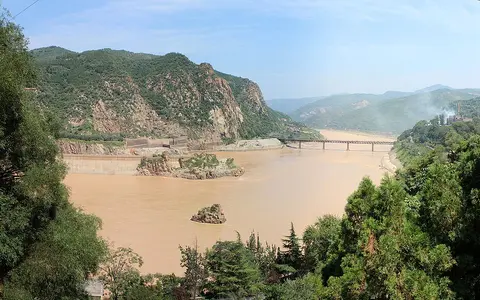

What the Yellow River is
The Yellow River, also called the Huang He, is a major river of northern China. It rises in high terrain in Qinghai, arcs through interior basins and plateau margins, then turns across the North China Plain toward the Bohai Sea.
As a physical geography subject, the river is best understood as a sequence of headwater meadows, mountain and plateau corridors, a large northern loop, deeply eroded loess tributary terrain, confined lower reaches, and a shifting coastal outlet plain.
Highland headwaters in Qinghai
The river begins on the northeastern Tibetan Plateau in the Bayan Har mountain region of Qinghai. Cold upland conditions, snow-influenced runoff, alpine wetlands, and plateau lakes help organize the upper basin before the channel descends toward lower northern China.
This source setting gives the Yellow River a strong upstream contrast. The upper river starts in high, comparatively cold terrain, then enters drier interior sectors where evaporation, tributary timing, and valley confinement become important parts of the watercourse.
Ordos Loop and plateau margins
One of the river's defining landform patterns is the Ordos Loop, where the channel bends north, east, and south around the Ordos Plateau. This loop marks a broad interior passage between uplands, desert margins, and loess-covered terrain.
Downstream of the loop, the river approaches the Loess Plateau, where tributaries cut through fine wind-laid sediment. The basin here is not simply a valley floor; it is a drainage network of gullies, ravines, tablelands, and erodible slopes feeding sediment toward the main channel.
Plateau source terrain
High Qinghai source areas establish the river before it turns through northern China.
Loess Plateau tributaries
Fine sediment, gullied slopes, and seasonal runoff give the river its distinctive sediment character.
Bohai Sea connection
The lower river reaches a low coastal plain and enters the shallow Bohai Sea.
Tributaries, sediment, and seasonal flow
The Yellow River's water and sediment regime reflects several environments at once: plateau headwaters, semi-arid interior basins, loess uplands, and the monsoon-influenced lower basin. Major tributaries such as the Wei, Fen, Luo, Tao, and Wuding add runoff from contrasting terrain.
The Loess Plateau is central to the river's physical identity because its fine, easily eroded deposits can be mobilized by storms and tributary flow. This sediment load affects channel form, floodplain behavior, and the lower river's alluvial setting.
Monsoon margins and dry interior controls
The basin sits across a climatic transition between high plateau source areas, dry continental interiors, and East Asian monsoon rainfall zones. Summer rainfall supplies much of the seasonal runoff in the middle and lower basin, while dry periods reduce flow and expose the importance of storage, tributary timing, and groundwater-linked baseflow.
This climate setting helps explain why the Yellow River differs from more humid East Asian rivers. Its flow is shaped by uneven rainfall, high evaporation in some basin sectors, variable tributary contributions, and sediment-producing storm events over loess terrain.
North China Plain and Bohai Sea outlet
After leaving the loess and mountain-margin sectors, the lower Yellow River crosses the North China Plain. The low gradient and heavy sediment supply have produced broad alluvial surfaces, leveed reaches, and a lower course where the relationship between channel bed, floodplain, and coastal plain is especially important.
The river enters the Bohai Sea, a shallow gulf of the western Pacific margin. At the coast, sediment delivered from the basin contributes to deltaic and nearshore landforms, completing the river's passage from plateau source country through northern China's interior and plain landscapes.