
What the Florida Reef is
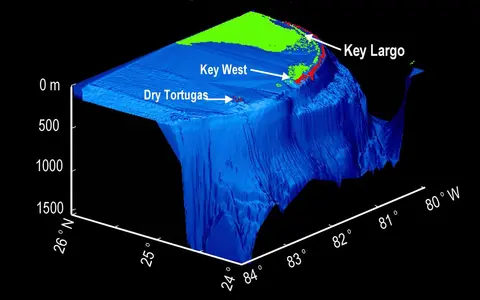
The Florida Reef is a regional reef tract rather than a continuous, high-standing barrier. It includes outer reef ridges, patch reefs, reef flats, hardbottom areas, sand channels, and low-relief carbonate surfaces arranged along the edge of the Florida Keys and southeast Florida shelf.
In physical geography terms, the reef belongs to the Florida Platform, a broad carbonate platform that also supports the Florida Keys, Florida Bay, the Dry Tortugas, and shallow shelf waters. The reef's shape is therefore tied to limestone bedrock, Holocene sea-level rise, shelf flooding, and the position of the Straits of Florida.
Along the seaward side of the Florida Keys
The most recognizable part of the Florida Reef lies south and east of the Florida Keys, from reefs off the upper Keys through the middle and lower Keys toward the Dry Tortugas. North of the Keys, coral and hardbottom communities continue along the southeast Florida shelf toward the St. Lucie Inlet area.
This position gives the system an arc-shaped geography. The Keys form a low limestone chain between Florida Bay and the Atlantic side, while the outer reef tract lies seaward of Hawk Channel and faces the Straits of Florida.
Outer reefs, Hawk Channel, and patch reef fields
The reef tract is organized by several parallel zones. Closest to the islands are nearshore flats, channels, and hardbottom. Farther seaward, Hawk Channel forms a long shallow corridor between the Keys and the outer reef line. Beyond that, reef crests, spur-and-groove zones, and fore-reef slopes face deeper water.
Patch reefs occupy parts of the shelf between the Keys and the outer tract. These lower, separated reef bodies help show why the Florida Reef is best understood as a mosaic of carbonate landforms rather than one uninterrupted ridge.
Seaward reef belt
Reef crests and slopes mark the exposed Atlantic side of the Keys shelf.
Long shelf corridor
A shallow channel separates much of the Keys island chain from the outer reef tract.
Broken carbonate relief
Small reef bodies, hardbottom, sand channels, and flats fill parts of the inner shelf.
Low islands beside a deep strait
The nearby land relief is very low. The Florida Keys are limestone islands and low coastal surfaces rather than a mountain-backed shore. Their small elevation range makes the surrounding marine relief more important than any terrestrial slope in defining the record.
The strongest contrast is offshore: shallow banks, reef ridges, and channels give way toward the Straits of Florida, where the seafloor drops into deeper current-swept water. That shelf-edge setting is central to the reef's form and to its connection with the wider western Atlantic.
Current flow, clear water, and bay exchange
Water movement around the Florida Reef is shaped by the Florida Current in the Straits of Florida, tidal exchange through channels, wind-driven movement across the shelf, and local links with Florida Bay and nearshore waters. The system is exposed to marine water from the Atlantic and Caribbean side while also sitting beside a broad, shallow back-bay environment.
Sediment and water clarity vary by position. Outer reef sectors are more directly influenced by clear marine water and wave exposure, while nearshore zones and channels respond more strongly to bay water, seafloor resuspension, rainfall, and coastal circulation.
Subtropical warmth, seasonal rainfall, and storms
The Florida Reef sits in a humid subtropical to tropical transition zone. Warm water, high sun angle, seasonal rainfall, and the influence of nearby warm currents help define the marine setting, while winter cold fronts and occasional cool water events distinguish it from lower-latitude Caribbean reefs.
Tropical storms and hurricanes are part of the physical geography of the reef tract. Storm waves can move sand and coral rubble, scour channels, reshape low islands, and alter reef-front relief. On the long timescale of the shelf, storm energy is one of the controls that keeps the system discontinuous and uneven.
Western Atlantic and Gulf links
The Florida Reef connects the Atlantic side of Florida with the Gulf of Mexico, Florida Bay, the Dry Tortugas, and the northern edge of the Caribbean-influenced western Atlantic. Its position near the Florida Current gives it a regional link to water moving out of the Gulf and through the Straits of Florida.
Within the atlas, the record pairs naturally with the reef hub as a subtropical shelf-edge example. It contrasts with the tropical barrier-and-lagoon pattern of the Belize Barrier Reef and the rift-margin shelf setting of the Red Sea Coral Reef.